
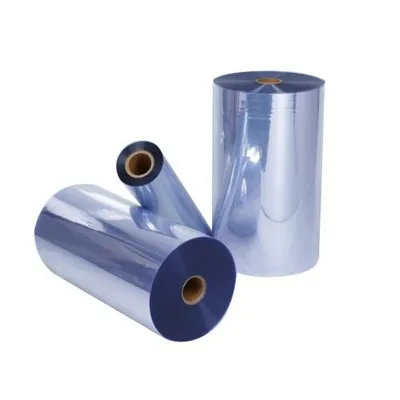
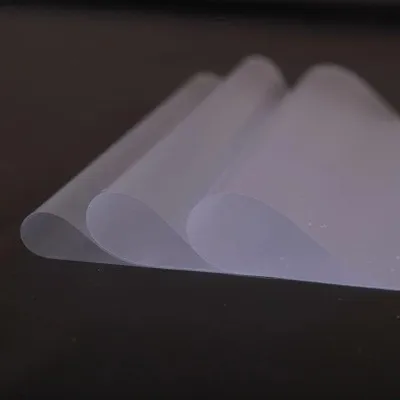
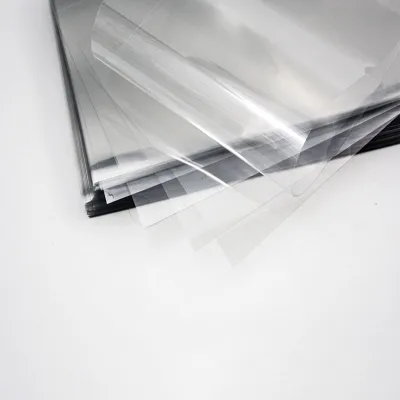
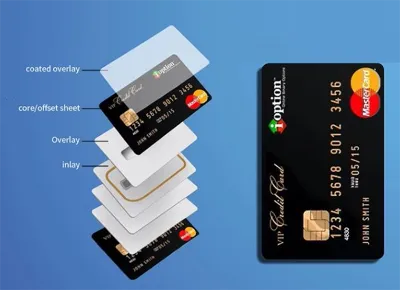
Most ID cards are made of plastic materials, and the most commonly used ones are PVC, PETG, and Polycarbonate. Some countries and regions also use anti-counterfeiting paper or Teslin synthetic materials with plastic sealing as national ID cards, driver's licenses, etc.
From PVC to PETG (modified PET), and then to the popular Polycarbonate material in recent years, especially in European and American countries, the market share of Polycarbonate materials in the card market has increased year by year. Today, the editor will explain the differences between these materials from three aspects: durability, anti-counterfeiting performance, and environmental protection performance.
| Item | Polycarbonate White Core Film | Polycarbonate Overlay Film |
| Color | White | Transparent |
| Thickness Range(mm) | 0.1-0.6 | 0.05-0.25 |
| Vicat Point(℃) | 150 | 150 |
| Surface Tension | 38 | 38 |
| Surface | Both sides matt | Both sides matt |
| Density | 1.3 | 1.2 |
| Application | ID card,E-Passport etc. |
Durability
PVC: PVC ID cards have relatively low strength and toughness, and are prone to breakage and scratches in long-term use. Its temperature resistance is average, and it may deform in high temperature environments and become brittle at low temperatures. Under normal use, the service life may be around 2-3 years. If the use environment is relatively harsh, such as high temperature, high humidity, frequent friction, etc., the service life will be shorter.
PETG: PETG material has good toughness and impact resistance. Compared with PVC, it can withstand a higher degree of bending and collision and is not easy to break. Its surface hardness is high and it is relatively not easy to be scratched. Under normal use conditions, it can maintain good appearance integrity. PETG has a wider temperature resistance range than PVC, and can maintain stable performance under certain high and low temperature environments. The service life can usually reach 3-5 years.
PC: ID cards made of PC material are extremely durable, have high strength and toughness, and have outstanding impact resistance among the three. They can withstand large external impacts without damage. It has high surface hardness, excellent wear resistance, and is not easy to scratch. PC has good temperature resistance and can maintain stable performance in a wide temperature range. It is not easy to deform or embrittle due to temperature changes. Under normal use, the service life can reach 5-10 years.
Anti-counterfeiting performance
PVC: PVC material itself does not have special anti-counterfeiting characteristics. It mainly relies on later printing and encryption technology to achieve anti-counterfeiting, such as special ink printing, optical anti-counterfeiting lamination or lamination.
PETG: PETG is similar to PVC. Its own anti-counterfeiting performance is not outstanding. It mainly relies on additional anti-counterfeiting technical measures, such as local optical anti-counterfeiting and fluorescent ink printing. Due to its smooth surface, the effect may be better than PVC when some special anti-counterfeiting treatment is carried out.
PC: PC material can achieve higher anti-counterfeiting performance through special production processes and adding special anti-counterfeiting elements, such as adding anti-counterfeiting fibers, surface laser etching, laser personalization, and secondary images during the production process. These anti-counterfeiting elements are closely combined with PC materials, and the anti-counterfeiting strength is relatively high.
Environmental performance
PVC: PVC may produce certain pollutants during the production process, such as residual vinyl chloride monomer, which is harmful to the environment and human health. Moreover, it is difficult to recycle PVC. When incinerated, harmful gases such as hydrogen chloride will be produced, which will pollute the atmospheric environment.
PETG: PETG is a relatively environmentally friendly material with relatively less pollution during the production process. It has good recyclability. Used PETG cards can be recycled and reprocessed and reused in the production of other plastic products, reducing the pressure on the environment.
PC: PC material has high environmental value and strong recyclability. Recycled PC material can be used again in production after processing. During use, PC material will not release harmful substances, which is friendly to the environment and human health, and meets modern environmental protection concepts and requirements.